Showing posts with label OSERS. Show all posts

Message to You from Alexa Posny

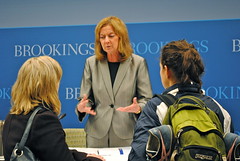
Alexa Posny speaks to audience members after t...
Alexa Posny speaks to audience members after the forum (Photo credit: Medill DC)


As you may have heard Alexa Posny is stepping down as Assistant Secretary of Education for OSERS, the Office of Special Education and Rehabilitative Services.  Dr Posny has been nice enough to allow me to interview her for the readers of this blog.This link is an index of the posts in the series presenting the interview.

When I heard that she was leaving, I asked her if she had any message for our readers as she left this important position.  I received this reply:

During my time at the Department, I served as a voice for State Chiefs, State Department and Local Education Agency Administrators, as well as educators and related services staff, helping the Department advance its agenda in the field.  The work and initiatives that I oversaw had a wide-ranging impact, from issuing IDEA Part C (Infants and Toddlers) regulations; to developing a disability policy strategy that integrates students with disabilities into all aspects of the department’s work; to supporting programs that help individuals with disabilities become gainfully employed, self-sufficient and independent; to supporting advances in disability research; and in administering billions of dollars through OSERS formula and discretionary grants.   I am honored to have been able to serve in this position and to serve this administration as we strive to improve results and outcomes for individuals with disabilities. 


Good luck Alexa.
Enhanced by Zemanta

Secretary Posny Speaks at CEC Conference

Alexa Posny speaks to audience members after t...Image by Medill DC via Flickr
The annual conference of the Council for Exceptional Children is underway.  I appreciate the good wishes I have received here at the beautiful National Harbor from a number of readers.

Alexa Posny, the Assistant Secretary of Education for Special Education and Rehabilitative Services,  spoke this morning.  I really admire Secretary  Posny.

She gave a list of six points she feels are important in the reauthorization of The Elementary and Secondary Education Act, the "general education" law.  The six fundamental concepts she outlined were:

  • ensuring that students are college or career ready. She described the critical  crossroads faced by students with disabilities at high school graduation. At this point, about 16% of students with disabilities complete post-secondary programs.
  • having the best teachers
  • meeting the needs of diverse learners (according to a recent poll students say that they learn best when doing hands on tasks, and next best by watching a hands on demonstration.  Last on the list was by receiving feedback from peers)
  • a complete education (including the fine arts; not just reading and math)
  • school as a safe and successful environment
  • fostering innovation and excellence( social and emotional as well as academic)(look for an increased role for positive behavior interventions and supports)

She also cited two other studies: of third graders who scored in the bottom 1/3 in reading, 63% of that group did not graduate from high school.  In other words, we lose kids if we don't have them reading at a fairly early age.

Another study Secretary Posny cited involved one of my pet projects- the role of poverty in education.  The 500 pound elephant in the room.  22% of children who have lived in poverty do not graduate from high school.  Only 6% of children who were never poor fail to graduate from high school.  We have to fix the problem of poverty or education reform is hopeless.  (The last point is mine- not the Assistant secretary's)

One other important point made by Secretary Posny in response to a question from the audience.was that the AYP calculation will be totally different in the reauthorized ESEA.  She predicted that an individual growth standard will be incorporated into the law.  The over reliance of NCLB upon tests will be reduced.
Enhanced by Zemanta

Posny Continues to Impress


I am at a conference on special education law as you now know. New OSERS Secretary Alexa Posny was here and she was very impressive. I am a bit biased because she granted this blog a big exclusive interview shortly after taking office. But her accessibility and willingness to answer questions is refreshing.

At this conference she gave a keynote address. She mentioned, for example, that as we approach the 35th anniversary of IDEA that we should review our successes as well as plan improvements for the future. For example, she pointed out that as of the latest statistics, 57% of special education students are in the general education classroom for more than 80% of the time. That is a lot of inclusion.

After the keynote, she held a question and answer session. She answered a lot of questions. I asked her about seclusion and restraints and the behavior provisions of IDEA. She stated that Positive Behavior Interventions and Supports was likely going to be developed a bit further in the reauthorization. In answers to other questions, she said that her dream is to merge the general education law, ESEA, and its funding with the special education law and its funding. She also indicated that a "growth model" approach was a likely change in the reauthorization of NCLB (or ESEA as it shall once again be called.) She also said that changes to the new regulations permitting parents to revoke consent for special education are not likely.

She also reiterated her support for using some special ed funds for early intervening services. Serving the very young is a definite priority for the new Assistant Secretary of Education.

She also wants to hear from you. She asked persons attending the conference to email her with ideas for reauthorization. This level of openness and transparency is unprecedented. I am pleased.

OCR to Collect Statistical Data RE: Seclusion & Restraints as well as Discipline of Students With Disabilities

Legality of corporal punishment in the United ...Image via Wikipedia


The Office of Civil Rights, like OSEP a division of the Office of Special Education & Rehabilitative Services, of the federal Department of Education, has announced that it will begin collecting statistical data about more than just harassment. OCR will now determine the frequency of the use of seclusion and restraints as well as the use of discipline for all students. The data will be disaggregated (statistics-talk for broken down by race, ethnicity, sex, disability and limited English proficiency. Here is the official OCR press release. OCR also has developed a new website where the data may be reviewed.

The addition of seclusion and restraints is not surprising. This is the current hot button issue in special education law, as it should be. The horror stories recently exposed that lead to the new legislation were not acceptable. Look for more regulation in this area.

The part that surprised me is the inclusion of student discipline stats in this data collection. This is potentially a huge development. You may remember that last August, I ran a post about a study that concluded that kids with disabilities are singled out for corporal punishment. Could this be what prompted OCR to look at discipline statistics? If so, it could be a signal that the OCR leadership considers districts who punish kids with disabilities disproportionately to be guilty of a civil rights violation? This would be news.

What do you think should OCR study or pursue the alleged over-disciplining of kids with disabilities as well as the abuse of seclusion and restraints? Stay tuned this could get very interesting.


Alexa Posny Interview - Part II


My recent interview with Dr. Alexa Posny, the new Assistant Secretary of Education for OSERS ( the Office of Special Education and Rehabilitative Services) covered a lot of ground. This is the second of a series of occasional posts concerning the interview over the next few weeks. NOTE: After today's post, this series will continue after the Christmas holiday. "JG" indicates that I am speaking. "AP" indicates that Secretary Posny is speaking.


Today's post concerns the mission and role of OSERS.

AP: Yes, and IDEA reauthorization is going to be coming up.

JG: Yeah, and I've got that on my list for you, believe me. Before we get to that though, in terms of the role of OSEP and the role of OSERS in general, in terms of what you do, how do you see the mission of your agency and the mission of OSEP within your agency?

AP: Okay, well, I'm sure you're very well familiar that OSEP and RSA, the Rehabilitative Services Administration and NIDRR, National Dissemination and Research arm of this, when I look at all of that, this is to serve infants, toddlers, youth and adults, in terms of for the K12 system, in terms of the academic and that part of the system, as well as leading them towards that career or their life in the future and which is where the VR comes into this. So, in terms of our mission, it's to make sure that any person with a disability is gainfully employed and has a great life, bottom line, and K12 is definitely a precursor to that and that's where OSEP plays the major role. You know, they do it and the Part C, of course, is 619 and then, of course, K12 and all the way through 21 or whatever, and that's then where RSA and the rest of it picks up afterwards, you know, to make sure that especially those adults with disabilities - - who have significant disabilities - - of course, are provided what they need. So, how does OSEP fit in there? If we don't have a good system that's leading into what they need to do in terms of follow up, then anything we do in terms of VR, they can't redo what might have been lost, if we don't provide what the children need long before they get out of the public school system. So, in OSEP - - since I know OSEP so well - - that's been great. The other thing is, one thing that I've talked about, as much as we talk about no child left behind, some areas of concern within that, I believe that students with disabilities made tremendous progress over the last however many years as a result of holding all of our kids to be accountable and to make sure that they all succeed. So, I just think we've seen tremendous strides. I really do.

JG: And I think you're right. In terms of your job, how much do you think special ed is going to play? You also have vocational rehab I like to call it because I'm old (laughing) and the research functions, of course. But special ed seems to be the big-ticket item on the plate. Is that true, you think?

AP: It's very true and it's not because I want to slight the other pieces, but when you think of how much IDEA - - I mean, you are very aware of the volumes of regulations and laws that we have and that plays a big part in it. Now, I'm not saying that WIA, the Workforce Incentive and the Rehab Act and so forth don't have those pieces, but when you think about what is included in IDEA, that's why it's such a huge aspect, but there's another part of it. We have to make sure that we are inclusive, so I need to be in all of the discussions on the reauthorization of ESEA, every piece. So, because it's more of that piece that impacts the rest of the U.S. Department of Education, that's OSEP plays such a big role. But I also need to help them understand how RSA and NiDRR also play a piece in this and that's another piece. I want to help that rise to the surface, to let them understand how it fits together.

JG: Okay.

AP: So, you know, I think it's been slighted.

JG: Okay, and I think many people feel that way, but on the other hand, as you said, there's just so much money and so much law involved in the special ed, for whatever reason. I mean, if you look through the case law on rehabilitation, there's just nothing there.

AP: But it's nothing in comparison to case law that we have. That's right.

JG: It's hard to actually literally keep up. I try to read all the cases in special ed, including many of the hearing officer opinions because I think that there's a lot of good discussion and new ideas there, but it's just hard to read them all. There's so many.

AP: Absolutely, and just think about it. We've only had the law for about 35 years.

Reblog this post [with Zemanta]

My Big Interview Happens!


Well it happened! I got to interview Dr. Alexa Posny, the new Assistant Secretary of Education for the Office of Special Education Programs and Rehabilitative Services at her office in Washington, DC. There is photographic proof on the right. --->

Dr. Posny was very personable and extremely knowledgeable. It was also very apparent that she really cares about children with disabilities. I believe that she will be a very good Assistant Secretary. She has a tough job, but I'm convinced that she will do it well.

The details of the interview will be printed over the coming weeks. The interview lasted nearly an hour and there is a lot of material. So I will be sure to fill in the details as we go along. Thank you Dr. Posny. And thank you readers of this blog for giving us the credibility to get this scoop!


Reblog this post [with Zemanta]

Big Interview Next Week: I'm Really Excited

interviewImage via Wikipedia


OK, I'm officially excited. I get to interview Dr. Alexa Posny, the Assistant Secretary of Education for Special Education and Rehabilitative Services, for this blog next week. This is a big deal! And you made it possible by reading and subscribing to the special education law blog. Thanks guys.

Although I probably have more questions than I can use in the allotted time, I still welcome your ideas and thoughts about the interview. One cannot be too prepared can one? Please keep sending me your input and suggestions.

For some more background on the new Assistant Secretary who was formerly the Kansas Education Commissioner, I have included a couple new links. Here is the official biography of Alexa Posny. Here is a newspaper piece on the new Secretary by the Topeka Capital Journal.

My plan is to run the interview over a number of posts in the blog. It may take a while to get the posts together and published, but they will be here. So stay tuned for more.


Reblog this post [with Zemanta]

Senate Confirms Alexa Posny as Assistant Secretary of OSERS


On October 5, 2009, the U. S. senate confirmed Alexa Posny as Assistant Secretary of education for the the Office of Special Education and Rehabilitative Services. This portion of the Department has jurisdiction over special education and vocational rehabilitation, among other things. Here is a link to the OSERS website.

United States SenateImage by vassego via Flickr


Alexa Posny is currently the Commissioner of the Kansas Department of Education. She has formerly served as Director of the federal Office of Special Education Programs and as the state Special Education for Kansas. Here is an article from the Topeka Capitol Journal. Here is another biography of the Assistant Secretary.

I have seen her speak and she is a very effective and witty communicator. Good luck to the new Assistant Secretary from the special education law blog. I have already sent a written request for an interview.

Reblog this post [with Zemanta]

Alexa Posny Nominated as Secretary of OSERS


President Obama nominated Alexa Posny last week to serve as Assistant Secretary of Education for Special Education and Rehabilitative Services. Here is the official press release.

OSERS is the subdivision of the federal Department of Education that deals with both special education and vocational rehabilitation for adults. Here is a link to the OSERS website.

Alexa Posny is currently the Commissioner of the Kansas Department of Education. She has formerly served as Director of the federal Office of Special Education Programs and as the state Special Education for Kansas. Here is another biography of the nominee.

I have seen her speak and she is a very effective and witty communicator. Good luck to the nominee from the special education law blog.